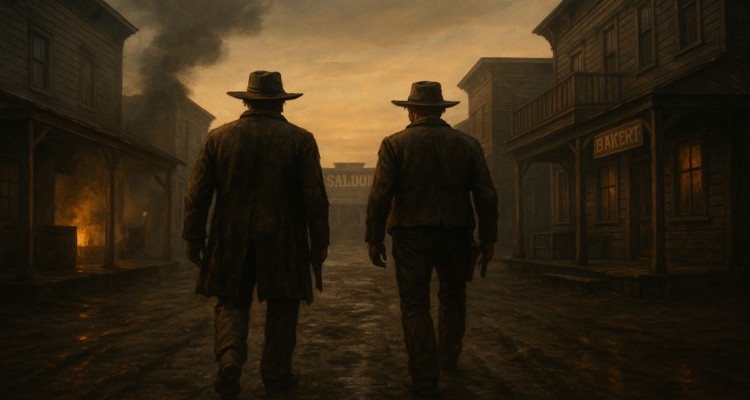
From the Front Porch series: Thorne Wilder & Brogo Mann | Chapter 13 of 13
The day we took Blackwell to court, Brogo wore his cleanest shirt. That didn't make it clean. It only meant the stains had names he remembered.
“Folks are more likely to believe you dressed respectable,” I told him.
“They should listen to what I say.”
“That's not usually how a court works.”
“No,” he said. “I noticed.”
The courthouse at Three Rivers was full by the time the judge took his seat. Farmers from Red Creek crowded the benches. Railroad workers stood along the walls. Ruth Mercer sat near the front with her children and the tin box of family papers on her lap.
Eli Vale had arrived during the night, battered but alive, with his station ledger wrapped in a coat. Nell Givens came from Red Creek and brought the surviving message slips. Ada carried the false survey. Wren held his handwritten duplicate record so tightly his fingers had turned white.
Pike and Vance stood at the back like men who expected the roof to collapse if anybody looked at them directly.
Judge Amos Fenwick was an old man with the face of a dry apple and the hearing of a wolf. He studied the crowded room and the stack of records before him.
“Mr. Wren,” he said, “I understand you are alleging forgery, fraudulent conveyance, and interference with a public watercourse.”
Wren stood. His voice shook. He cleared his throat and began again.
“Yes, Your Honor.”
“Then start at the beginning. Leave out nothing you can prove and everything you cannot.”
That was the kind of instruction Thorne liked from a judge.
Wren showed the original survey copy against the amended map. He identified changed bearings and a dead surveyor's signature. Ada produced telegraph records directing the movement of car seventeen and instructions from Blackwell's office. Vale authenticated the freight manifest. Nell testified to Rook's instructions and the search of his room.
Then Brogo placed Rook's field books on the table, still stained from the storm at Cinder Wash. Each page recorded measurements along Red Creek. He laid beside them his own rough sketch of exposed roots and polished stones.
“Did you make these measurements?” Blackwell's lawyer asked.
“Made the sketch,” Brogo said. “The creek made the rest.”
The lawyer pursed his lips. “Are you a licensed surveyor?”
“No.”
“Then perhaps we should disregard your opinion.”
Brogo looked at the judge. “You can disregard me. Water still runs downhill.”
A little laughter moved through the room until the judge tapped his desk.
Ruth Mercer took the stand next. She described the diversion gate, the empty channel, the purchase offer, and the men who came to her home at night. Her older child whispered something to her as she sat down. Ruth smiled, though tears stood in her eyes.
Pike testified after a long argument with himself. He admitted that Blackwell's company had promised him favorable grazing land if he helped make trouble between rival ranches. Vance admitted the same, though he claimed to have discovered the arrangement later than Pike did. The judge listened without deciding whether either deserved sympathy.
Finally, Nathaniel Blackwell entered the room under escort by the county marshal. His clothing was immaculate. His expression belonged to a man who believed a court was merely another office where business could be arranged.
His lawyer challenged the records, the witnesses, and the court's jurisdiction. The judge permitted the questions and demanded answers. By afternoon the contradictions had grown too large to fit under any single explanation.
Fenwick issued temporary orders preventing the disputed transfers and requiring that the diversion gate be opened pending further proceedings. He directed the marshal to secure the original records and ordered an investigation into the forged documents and threats against witnesses.
It was not a final verdict. Nobody declared the entire matter finished.
But the water could flow again while the law caught up.
Outside the courthouse, the crowd exhaled as though it had been holding one shared breath for days. Ruth Mercer gripped Ada's hands. Wren sat on the steps and laughed for no reason he could explain.
Thorne walked to Blackwell's waiting carriage. The polished doors stood open, unattended now.
“There's something I don't understand,” he said to Brogo.
“Only one thing?”
“Don't start. Blackwell was ready to lose the survey. He was too calm.”
Brogo turned toward the courthouse door. “We gave him a reason to be careful.”
“Or we haven't found the last paper.”
They returned to Vale's ledger and examined the final entries. One freight payment, recorded under a code they had overlooked, listed a deed transferred to a holding company with an unfamiliar name: NORTH FORK DEVELOPMENT.
Ada frowned at it. “Blackwell doesn't own North Fork.”
“Who does?” Thorne asked.
“No one I know.”
The judge had already secured the original records, but Wren made a note of the entry for the investigation. No one could say what it meant or whether it was connected to the creek fraud.
Two days later, Thorne and Brogo rode through Red Creek valley. The diversion gate stood open. Water moved over the stones of the old channel, slow at first, then swift enough to carry a twig past the Mercer mill.
Ruth waved from her porch. Her children ran to the bank and splashed their boots. The mill wheel creaked once, stopped, and turned again.
Brogo sat his horse and watched the wheel.
“That's a good sound,” he said.
“Better than bullets.”
“Most things are.”
They stayed for supper and helped reset a fence post before riding west. The road out of the valley climbed through cottonwoods toward a country neither man had seen before.
Thorne carried no satchel now. He felt lighter and more suspicious for it.
That evening on the porch, years later, Brogo asked whether he thought they had won.
“We stopped one theft,” Thorne said. “That's something.”
“And the other paper?”
“North Fork?”
Brogo nodded.
Thorne turned his cup in his hands. “I never liked a ledger with a last page missing.”
From the fence line came the sound of an approaching horse. The visitor was a young woman in a dust-gray coat with an envelope tucked beneath her arm. She waited until Thorne looked up.
“Mr. Wilder? Mr. Mann?”
“Depends who's asking,” Thorne replied.
“I'm looking for two men who once found a creek the railroad had misplaced.”
Brogo set down his coffee. Thorne looked at the envelope and saw the same tiny blue cross Wren had used to mark the forged records.
“Well,” Thorne said, “come up on the porch.”
And somewhere down the long road, another story was already looking for them.