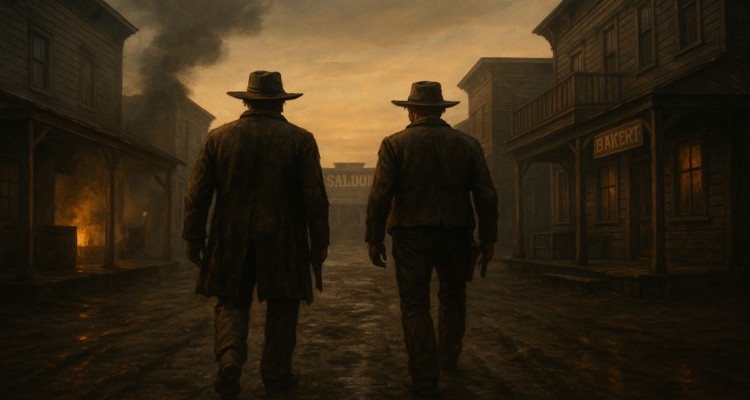
From the Front Porch series: Thorne Wilder & Brogo Mann | Chapter 11 of 13
Thorne liked courthouses about as much as he liked dentists, which was not at all unless somebody had given him a choice between the two.
“Courthouse is where a man can steal a valley without getting his boots dirty,” he said.
Brogo rocked slowly beside him. “Somebody still has to carry the papers.”
“That's what makes clerks dangerous.”
Three Rivers rose around a courthouse square shaded by elms older than most of the town. Wagons circled a watering trough. A church bell rang noon. Across from the courthouse, the sign on a brick office read NATHANIEL BLACKWELL, LAND AND TRANSPORTATION.
It was the kind of sign that announced a man expected to be believed.
Ada Bell traveled separately and reached the town ahead of them. She had arranged a meeting with Thomas Wren, deputy clerk of records, who kept a private copy of anything he feared might be altered. That habit had nearly cost him his job.
They found Wren behind a stack of tax rolls. He had spectacles that never quite stayed on his nose and a nervous twitch in one eye.
“Close the door,” he whispered. “A man asked for those papers this morning.”
“Good,” Thorne said. “Means we're in the right office.”
“No,” Wren replied. “It means you're late.”
He placed two survey sheets side by side. One showed Red Creek winding past the Mercer farm and through the eastern meadow. The other placed the channel far west, beyond a line of new purchases by Blackwell's subsidiaries.
The paper was the same size. The stamps were nearly identical. The signatures belonged to the same surveyor, a man Wren knew had died months before the second survey was supposedly made.
“How'd that get filed?” Brogo asked.
“An emergency land amendment. Blackwell's lawyer argued that the original creek coordinates were a copying error.”
“And you believed him?”
“I didn't. The senior clerk signed anyway.”
Wren opened another book. Water-rights registrations. Some entries had been erased and rewritten. Others contained new names in the margins, names corresponding to the men who had arrived at Ruth Mercer's cabin with a wagon and a sales paper.
“Where's the senior clerk?” Thorne asked.
“Gone to visit a sick cousin. He has no cousin.”
Through the frosted office window, the shadow of a man stopped in the hall. Wren froze. The knob turned once, slowly. Then the shadow moved away.
“There's a side entrance,” Wren whispered.
“We haven't got all the papers,” Ada said.
Wren pulled a thick ledger from beneath his desk. He had copied the contested records by hand and marked each discrepancy with a tiny blue cross.
“Take this. If the judge reads it alongside the field books, he'll see what happened.”
“Why help us?” Brogo asked.
“Because my father farmed on that creek. He's buried where the new map says water never ran.”
They left through the records room into an alley. Thorne noticed a boy sweeping the courthouse steps, watching them through lowered lashes. The boy turned and ran toward Blackwell's office.
“They've got every doorway covered,” Thorne said.
Brogo nodded toward the livery. “Then we take the one they forgot.”
They crossed the square in the shadow of a hay wagon. Ada carried the ledger inside a sack of laundry. Wren followed with a coat pulled over his face.
At the livery, the stable keeper barred the door behind them. He had once driven freight for Elias Rook and wanted to know why Rook never came home.
Thorne told him the truth, or as much as he knew.
The keeper nodded without speaking, then saddled four horses from stalls behind the tack room.
Before they could mount, a voice came from the loft.
“Those books aren't yours.”
The man in the white scarf stood above them, pistol held low. Calder had cut his way free at Cinder Wash and reached Three Rivers before they did.
“Funny,” Thorne said. “They weren't Blackwell's either.”
Calder fired into the dirt by Wren's boot. “Put them down.”
Brogo glanced upward. Above Calder's head hung an iron pulley and a heavy grain sack. The rope securing it had frayed near the knot.
“Always stand clear of a load,” Brogo said quietly.
“What?” Calder demanded.
Brogo pulled the loose end.
The grain sack swung down between Calder and the stable floor. Calder staggered backward, lost his footing, and disappeared into a pile of loose hay with a surprised curse.
Nobody waited to learn whether his pride was injured. They rode out the rear gate at a gallop, the ledger pressed tight against Ada's chest.
That evening they stopped beside an abandoned lime kiln. Wren opened his notebook by firelight and studied the copied signatures.
“I thought the worst thing they could steal was a map,” he said.
Thorne fed a stick into the coals. “Map's just the tool.”
“What are they stealing?”
Brogo looked west toward the farms. “Choices.”
Above the kiln, thunder moved over the hills. The district judge would hear the matter at dawn, if Blackwell let him.