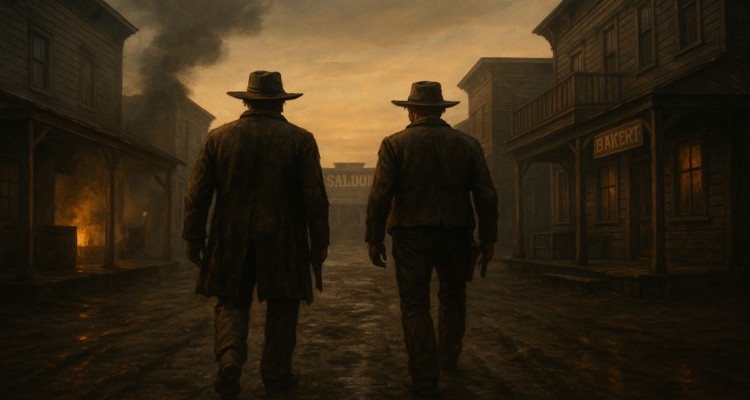
From the Front Porch series: Thorne Wilder & Brogo Mann | Chapter 10 of 13
Brogo said a bridge ought to be judged by the side you reached, not the view from the middle.
I asked him if that was wisdom.
“No,” he said. “That's carpentry.”
The railroad's temporary bridge at Cinder Wash was a rough timber span laid across a ravine that carried nothing for most of the year and too much when storms came. On the day Thorne and Brogo arrived, clouds were piling over the western rim, black underneath and silver where the sun fought them.
Car seventeen stood on a siding beside a gravel pit. Its door was chained, and two guards sat in the shade of a supply wagon with the indolent posture of men paid to discourage conversation.
Ada Bell waited beyond the work camp in a stand of mesquite. She had traded her vest for a canvas coat and carried a small leather case strapped across her shoulder.
“You're behind schedule,” she said.
“Railroad's always running late,” Thorne answered.
“Not this railroad. It runs exactly when Blackwell needs it.”
She showed them a sketch of the camp. The loaded freight would depart at first light. The bridge crew had been told to send all nonessential men away before then.
“What's in the car?” Brogo asked.
“Records, if Rook told me true. Original survey books, purchase warrants, and enough false shipping invoices to make every clerk between here and the capital nervous.”
“Why move them?”
“They're going to burn the originals once the amended map is filed. A man can't challenge a survey he can't produce.”
Thorne looked at the guards. “Two in sight.”
“Four more near the bridge,” Ada said. “And the one in the white scarf.”
They waited until the work whistle called men to supper. A wind rose ahead of the storm, bending the grass. Ada approached the guards carrying an official-looking message. While the men argued over the seal, Thorne slipped behind the car and examined its chained door.
Brogo found the locking pin half worn through. With a pry bar borrowed from the maintenance pile, he eased it out without striking metal. The door opened one hand's breadth, then a foot.
Inside, timber crates held ledger books wrapped in oiled cloth. Each was stamped B.C. CONSOLIDATED, BRIDGE SUPPLIES. Thorne opened the nearest and found a surveyor's field journal, its pages filled with water levels, bearings, and distances along the very creek the company claimed had never run through Mercer's farm.
“Here's the honest water,” he whispered.
Brogo handed down two books, then a third. The sky cracked with thunder.
The guards shouted. Ada's diversion had ended.
“Move,” Brogo said.
They sprinted toward the mesquite with three journals and a sealed packet. A rifle fired behind them, splintering a crate. Thorne turned just long enough to cover Ada's retreat.
The first rain struck like thrown gravel. Within minutes the gravel pit became a run of red mud. Camp laborers struggled to secure tents. Horses plunged against their lines.
At the far side of the siding, the white-scarf rider stepped into their path. He was younger than Thorne expected, with a pale scar along his jaw and a pistol held steady despite the wind.
“Leave the books,” he said. “You can walk away.”
“People keep offerin' us that,” Thorne replied. “Makes a man suspicious of the road.”
Brogo moved sideways, not reaching for a weapon. The rider tracked him with the pistol. That gave Ada time to bring the butt of her telegraph case down on the man's wrist.
The shot went into the rain. Thorne knocked the pistol aside. Brogo pushed the man against a wagon and tied his hands with a trace chain.
“Name?” Brogo asked.
“Calder.”
“Who pays you?”
Calder spat mud. “You're all dead by morning.”
“Then you got time to answer.”
Before he could, a shout rose from the bridge. The wash, dry an hour before, had begun to fill. Men scrambled for higher ground. A mule team broke loose near the span, its driver trapped beneath the wagon tongue.
Brogo left Calder and ran to the bridge. Thorne cursed and followed.
The water came brown and fast, carrying limbs and stones. Brogo waded to the wagon while Thorne tied a rope around a post. Together they freed the driver and hauled him clear moments before the wagon lifted and struck the bridge supports.
One timber cracked. Then another.
Ada stood on the bank with the journals under her coat. The driver, shaking and muddy, looked at the two men who had saved him.
“What can I do?” he asked.
“Tell us where the rest of those books were going,” Thorne said.
The man pointed south. “Blackwell's private office at Three Rivers. Everything goes there for a week, then east by express.”
The bridge shuddered. Car seventeen rolled an inch as a coupling strained against its brake. A cry went up from the work crew.
Calder was gone. The trace chain lay in the mud, its fastening cut.
Brogo stared at the collapsing span. “We can't take the track.”
Thorne tucked a soaked journal into his vest. “Then we take the old road.”
Ada looked at the black water. “That road runs through Pike's range.”
“Pike already hates us,” Thorne said. “Might as well give him somewhere convenient to do it.”
Behind them Cinder Wash swallowed the bridge with a sound like a great door being slammed shut.