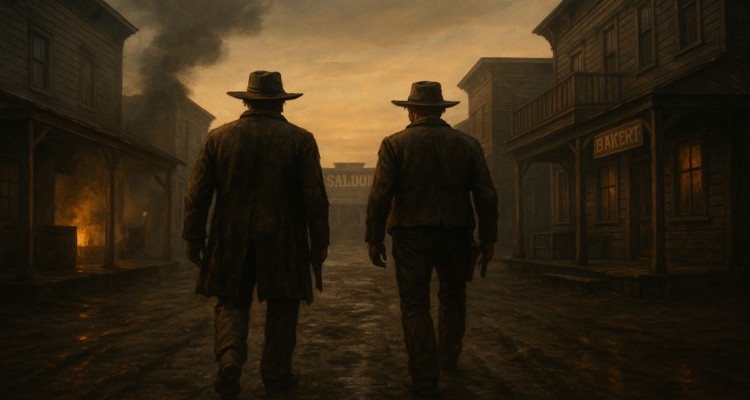
From the Front Porch series: Thorne Wilder & Brogo Mann | Chapter 6 of 13
The morning porch had a cold nail in it. Wind worked along the loose boards, making one of them complain every time Brogo shifted his boot.
Thorne sat with a cup in one hand and a knife in the other, whittling a piece of cedar down to something that might someday deserve a name.
“You remember those four fellas on the ridge?” he asked.
“Remember you countin’ them twice.”
“I like to be certain about threats.”
“You like to be certain about numbers. Threats you collect without countin’.”
Thorne considered that a moment. “I suppose that is a difference.”
Brogo watched fog lift from the pasture. “They weren’t followin’ to shoot.”
“No?”
“If they wanted to shoot, they’d have shot.”
“Then what were they after?”
Brogo leaned forward to warm his hands around the cup. “Wanted us to go where they wanted us.”
That was the morning we rode into Red Creek Junction, and for once Brogo’s suspicion arrived before the trouble did.
The four riders never came close enough to make out faces. Each time Thorne and Brogo changed direction, a figure would appear along a distant rise. Never two in the same place. Never anybody fool enough to leave a fresh track where Brogo might read it.
By noon the land narrowed between a dry bluff and a creek that carried more mud than water. A rutted wagon road ran east. Beyond it, the iron rails of the Red Creek spur flashed in the sun.
“They’ve left us one road,” Thorne said.
“Two, if you count the creek.”
“I don’t count drownin’ as travel.”
“Then one.”
At the junction, the town had been built as though nobody expected it to last. A depot, a livery, a store with a false front, a boardinghouse, and three saloons all stood in a wind that seemed to want the structures for itself. A water tower leaned over the track. From its shadow a freight engine breathed and knocked.
A boy selling apples at the station platform studied the two riders, then the satchel lashed behind Thorne’s saddle.
“Best take that inside,” he whispered.
Thorne stopped. “Why?”
“Because Mister Vale’s been askin’ who carries it.”
The boy was gone before Thorne could ask anything more.
They found the station agent in a cramped office behind the telegraph key. He was gray at the temples, with neat cuffs and ink on the sides of his fingers. His nameplate read ELI VALE.
He looked up at Thorne’s hat, then Brogo’s rifle, then the satchel.
“Freight inquiries are handled outside,” he said.
“This isn’t freight.” Thorne put the satchel on the counter.
Vale’s face hardly moved, but his hand did. It slid a ledger shut as though hiding it from rain.
“Where did you get that?”
“From a dead driver,” Thorne said. “And before you ask, we didn’t make him dead.”
Vale stared at the cracked leather flap. “His name was Elias Rook.”
“How’d you know?” Brogo asked.
Vale did not answer directly. “He was meant to bring something to the district survey office. He never arrived.”
“Seems there’s a lot of that goin’ around,” Thorne said.
The agent lowered his voice. “You need to leave. The next eastbound departs at sundown. I can get you aboard.”
“We’re not interested in a train ride,” Brogo said.
“That’s the only safe interest left in town.”
Outside, a horse stamped. Vale looked toward the window, and in that glance Thorne saw something worse than a liar. He saw a frightened honest man who had already made one bad bargain.
“Who is Mister Blackwell?” Thorne asked, pulling a name from the papers.
The station agent swallowed. “A man whose companies own more track on paper than the railroad has laid on earth.”
“Does he own you?”
“Not yet,” Vale said. “And that may be my trouble.”
A whistle sounded from the freight yard, long and mournful. Brogo moved to the door and watched two men step off the platform carrying rifles inside rolled blankets.
Vale pressed a brass freight token into Thorne’s palm. One side carried the number seventeen. The other had been scratched with a tiny X.
“Ask for Ada Bell at the telegraph room when the night shift changes. Tell her Rook kept his promise.”
Thorne closed his fingers around the token. “And what promise was that?”
Vale reached for the ledger he had just concealed. Then a shot cracked outside, punching a neat hole through the window above his shoulder.
Brogo pulled him down behind the desk. Thorne kicked the lamp away from falling paper.
The second shot struck the doorframe.
“Reckon the night shift’s early,” Thorne said.
Brogo looked at the brass token. “Reckon we got the right town.”
They slipped through the coal door into a yard full of smoke, iron, and men who suddenly had pressing reasons not to see them. Behind them, Vale remained crouched beneath his desk. Ahead, the locomotive breathed like something too large to understand fear.
And somewhere in Red Creek Junction, a woman named Ada Bell was waiting on a promise from a dead man.