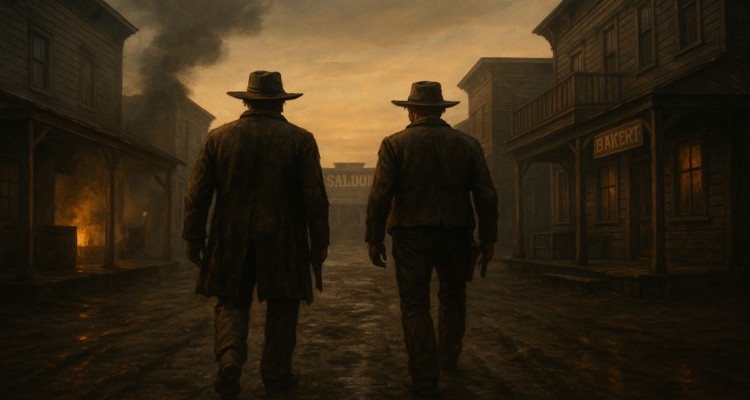
From the Front Porch series: Thorne Wilder & Brogo Mann | Chapter 7 of 13
Brogo never liked telegraph wires. Said a message ought to have to walk through the country it aimed to change.
“That’s foolish,” I told him one porch morning. “A letter can get a man killed as easy as a telegram.”
“Letter gives him time to consider.”
“Not if he reads fast.”
“Then he should read slower.”
I allowed him the point. In Red Creek Junction, the wires were the only thing moving faster than trouble.
Thorne and Brogo spent the afternoon in the loft of an abandoned feed shed beside the rail yard. Through a gap in the boards they watched a pair of strangers question the apple boy, then drag the station agent onto the platform. Vale answered in shrugs. When the men departed, he went back into his office, pressing a cloth to one bleeding ear.
“Shouldn’t leave him,” Thorne whispered.
“Can’t help him by gettin’ caught,” Brogo said.
“We could scare them.”
“They’re already scared. That’s why they’re mean.”
Near dark, the two men crossed between boxcars and found the rear stairs to the telegraph room. A narrow window glowed with the light of one oil lamp.
A woman in a dark vest opened the door before they knocked. Her hair had been pinned back with two pencils. She held a heavy telegraph wrench as though deciding whether it would improve a stranger’s manners.
“Token,” she said.
Thorne showed her the brass disk.
“Rook kept his promise,” he added.
The wrench lowered an inch. “Rook is dead.”
“He is,” Brogo said.
She looked at them a long time, then stepped aside. “Come in before somebody sees your shadows.”
Ada Bell was younger than Thorne expected, though the quiet in her face belonged to a person who had spent years hearing the wrong things said aloud. The room held a map, a clock, a row of message slips and the telegraph sounder ticking against a wooden board.
“The token means car seventeen,” she said. “Rook was to deliver the papers and tell me where the copy went.”
“A copy?” Thorne said.
“You think a man carrying stolen contracts rides with only one set?” She pointed to the rail yard. “A sealed dispatch case went through three nights ago under the name of bridge hardware. There’s no bridge hardware in it.”
“Who sent it?”
“Blackwell Consolidated. Signed by a surveyor who died last winter.”
Brogo moved closer to the map. “Dead men sign easy.”
Ada tapped a point where the creek bent south. “A new rail right-of-way crosses the public watercourse here. But the filed survey moves the channel west. When the county accepts that map, the farms east of the line lose their recognized access.”
Thorne thought of families carrying buckets across fields. “Who benefits?”
“Land buyers who already know the map is false.”
The sounder began to chatter. Ada pressed a finger to her lips and copied the message as it came. Her pencil moved without hesitation. At the final pause, she read the slip once and closed her eyes.
“What?” Thorne asked.
“Blackwell’s foreman is arriving on the midnight freight. Orders say the station agent is to surrender the Rook satchel and all correspondence.”
“Orders from who?”
Ada set down the slip. “Nathaniel Blackwell himself.”
Brogo glanced at the window. “They know where we are?”
“Not yet. But they know you are here.”
Outside, a locomotive coughed into motion. Ada opened a small safe and removed a packet tied with blue thread. Inside was a copy of the disputed survey. The creek had indeed been shifted on the paper, its original bend erased with pale scraping marks.
“Can you send word to somebody honest?” Thorne asked.
“I have,” she said. “Twice. Neither message reached the recipient. There’s a relay office east of here that copies everything Blackwell considers important.”
“Then we carry it,” Brogo said.
Ada folded the map and pushed it into a waxed wrapper. “Judge Amos Fenwick holds district court at Three Rivers on Friday. If he sees the original field notes and this false survey together, there may be enough to stop the transfer.”
“And if he don’t?”
“Then Blackwell owns the creek on paper. Once the rails arrive, his men will make the paper true.”
They heard boots on the stairs.
Ada snatched the telegraph slip and fed it into the lamp flame. Thorne slipped behind a cupboard. Brogo stood beside the stove with a coal shovel in his hand.
A man called through the door. “Evening wire inspection.”
Ada answered without looking up. “Come back at dawn.”
“Blackwell’s instructions.”
“Then bring Blackwell a ladder. The outside insulators are where the trouble is.”
There was a pause. The steps retreated.
Thorne let his breath out slowly. “You’re very good at lying.”
“Telegraph work teaches you when people believe what they want.”
She passed Brogo the map and a narrow envelope. “If you get separated, the envelope tells the judge whom to trust.”
At the stairwell door she stopped them. “One more thing. Car seventeen isn’t going east tonight. The railroad changed the manifest an hour ago.”
“To where?” Thorne asked.
“South. To the temporary bridge at Cinder Wash.”
Brogo rolled the map into his coat. “Then the bridge is where we go.”
When they stepped into the alley, the midnight whistle blew, and four horsemen rode between the depot and the freight platform. One wore a white scarf tied high over his collar.
Thorne recognized the rider from the ridge. A man who had been directing them all day.
The rider looked toward the telegraph window and raised a hand.
The lamp inside went dark.