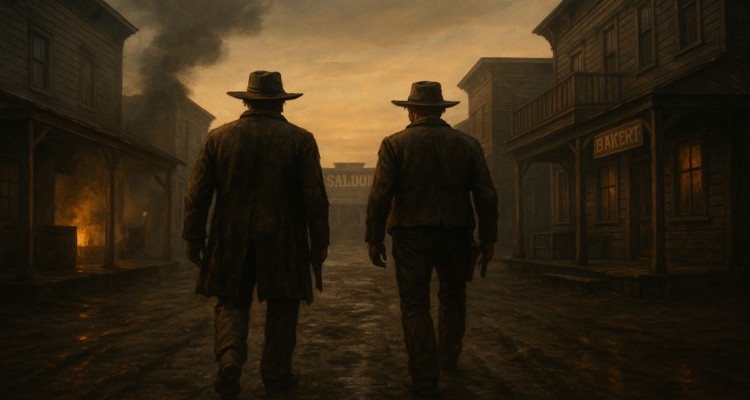
From the Front Porch series: Thorne Wilder & Brogo Mann | Chapter 9 of 13
The trouble with riding back into danger is that you arrive tired and danger is usually fresh.
Thorne made that observation one evening on the porch while Brogo repaired a leather strap.
“You'd have saved us trouble if you'd listened to yourself,” Brogo said.
“I always listen to myself.”
“Then you got a strange way of showin' it.”
The riders approaching Ruth Mercer's farm came without lanterns. There were three of them, and one led an empty packhorse.
Thorne and Brogo cut across a dry pasture and reached the cabin first. Brogo went to the rear window while Thorne knocked on the door.
“Mrs. Mercer, you need to wake the children.”
She opened it carrying a lamp. Behind her, the youngest child was already crying.
“Who's there?”
“People who don't want witnesses.”
They had scarcely moved the family into the cottonwood grove when the riders arrived. One shouted for Ruth to come out and sign the sale. Another broke a window. The third lit a rag and flung it toward the roof.
Thorne fired into a fence post near the man's boot. The rider dropped the burning rag and fled toward his horse. Brogo stepped from the trees, rifle ready, and the other two decided the night was less agreeable than they'd expected.
When the dust quieted, Ruth stood with her children in the grove, holding her tin box and nothing else.
“Can we come home?” the little boy asked.
“Not tonight,” she told him.
A neighbor arrived with a wagon and took them west. Thorne gave him a note for the sheriff of Three Rivers, though he had no way to know whether that sheriff was honest.
By dawn the two men returned to Red Creek Junction. They needed Ada's original message slips and the railroad manifest for car seventeen. Both might tie the forged survey to the people who had ordered it.
The station agent's office was closed. Eli Vale had disappeared. A padlock hung on the telegraph-room door.
Ada was gone too.
A notice in the depot window read: TELEGRAPH SERVICE SUSPENDED FOR REPAIR.
“Convenient,” Thorne said.
“Careful,” Brogo answered.
A porter carrying coal paused beside them. “Miss Bell left a parcel for the laundry woman. Said if two dusty idiots came asking, she'd know where to send them.”
“How'd she describe the idiots?” Thorne asked.
“Didn't need to.”
He pointed toward the boardinghouse. The laundry woman was a stooped widow named Nell Givens, who answered the door with sleeves rolled above her elbows and a look that could have spoiled milk.
“You're late,” she said.
“Didn't know we had an appointment,” Thorne replied.
“People always say that before they make trouble for somebody else.”
She pulled a cloth-wrapped bundle from under a basin. Inside were duplicate telegram slips and a corner of a freight manifest bearing a numbered seal: 17, Cinder Wash, PRIORITY GOVERNMENT MATERIAL.
“Government?” Brogo said.
“That's what they're pretending,” Nell answered.
A bell rang in the street. Someone shouted fire.
Nell opened the curtain. Smoke rose from the shed behind the boardinghouse, where linen hung on lines between posts.
“Get my boarders out,” she said, already reaching for a bucket.
The fire had been set at two corners. Thorne could smell kerosene before he saw flames. He dragged a sleeping railway worker down the stairs while Brogo pulled a water barrel into the yard and cracked its lid with the butt of his knife.
Men ran with buckets. Somebody cut loose the horses. The burning shed collapsed in a red burst that showered the yard with sparks.
Through the smoke Thorne saw the rider in the white scarf watching from the opposite alley. Their eyes met. The rider turned and vanished.
When the last boarder was safe, Nell stood in front of the blackened shed, her face streaked with soot.
“Second time,” she said.
“What was the first?” Brogo asked.
“Rook's room. They searched it the night he left.”
Nell reached into her apron and produced an oilskin-wrapped notebook.
“He gave me that. Said if he didn't come back, I was to find a woman who could send a message farther than Blackwell's money.”
“Ada,” Thorne said.
Nell nodded. “She went south to Cinder Wash yesterday. Took the old service trail. And she said don't trust the freight clock.”
Thorne opened the notebook. Numbers covered every page, arranged in columns with dates and symbols. On the last page, written in a different hand, were five words: THE BRIDGE IS THE RECEIPT.
Brogo read them once. “Means nothing by itself.”
“That's how receipts are,” Thorne said. “Always make sense after somebody's been robbed.”
Behind them the boardinghouse roof dripped smoke into the morning sky. Nell folded her arms.
“If you two are going to make enemies of powerful men,” she said, “at least do it somewhere they can't burn my laundry.”
Thorne tipped his hat. “We'll see what we can arrange.”
As they rode south, one of the depot bells began to ring though no train was due. Then the telegraph wires above the road gave a sudden sharp hum, like a warning nobody had learned to read.