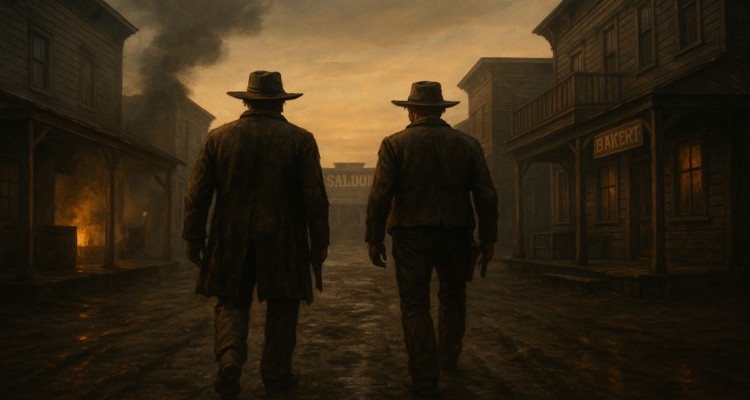
From the Front Porch series: Thorne Wilder & Brogo Mann | Chapter 8 of 13
“Ever try to steal a creek?” Thorne asked over breakfast.
Brogo looked down at the coffee. “Hard to get it through a door.”
“That’s because you never met Nathaniel Blackwell.”
“Met enough like him.”
“Blackwell could steal rain while it was fallin’ and send the clouds an invoice.”
Brogo gave that a little consideration. “Wouldn’t surprise me.”
The first family they met east of Red Creek lived beside a channel that had once run ankle deep even in summer. Now the bed held dust and pale stones. A mill wheel stood still, one broken spoke pointing toward the sky.
The woman outside the cabin carried an empty bucket. She watched Thorne and Brogo dismount as if visitors were just another burden to put away.
“Water?” Thorne asked.
“If you brought some.”
He handed over his canteen. She looked inside, then at the two riders.
“You should keep it.”
“Got another,” he lied.
She drank once and handed it back. “I'm Ruth Mercer. If you're selling claims, you missed the last man who'd listen.”
Brogo said, “We're looking for the creek.”
Ruth gave a humorless laugh. “So are we.”
She brought them into a cabin where two small children waited beside a table covered in empty jars. Their father had been gone three days trying to negotiate with the irrigation company upstream. Before he left, the creek had run steadily through the place. Then a new diversion gate closed north of the valley, and the water vanished.
“We were told we had no right to it,” Ruth said. “The survey says our place was never on the channel.”
Thorne laid Ada Bell's copied map across the table. Ruth pressed a rough finger on the old creek bed, finding the bend without help.
“That's wrong,” she said.
“We know,” Brogo answered.
She led them to a cupboard and brought out a tin box. Inside were tax receipts, a faded land patent, and a hand-drawn map her husband had made before they were married. His lines were crooked but his landmarks were careful. A stone outcrop, a cottonwood grove, a ford. The stream was precisely where the official map denied it had ever been.
“Can we take a copy?” Thorne asked.
“You can take the whole thing if it gets my children water again.”
Brogo shook his head. “Keep your proof. We'll make our own.”
He spent an hour walking the dry bed, tracing stones polished by years of current and willow roots left exposed above the dirt. Thorne sketched the course into his pocketbook. At the old mill they found a survey stake that had been pulled and driven sideways into a new bank. The mark on its head matched the seal printed on Blackwell's altered survey.
When they returned, a wagon had come down the road. Two men in coats too fine for the dust stood beside it. One read from a document while the other examined the cabin as if measuring boards for salvage.
“Mrs. Mercer,” the reader said, “the company offers a fair purchase before formal enforcement.”
Ruth folded her arms. “You mean before you send men to move us.”
The man noticed Thorne and Brogo. “This is private business.”
Thorne smiled pleasantly. “Then speak quieter.”
The second man slipped his hand into his coat. Brogo moved half a step, enough to make the man think better of it.
“Your survey is crooked,” Brogo said.
“Your opinion has no standing,” the reader replied.
“Creek did,” Brogo said. “Till you moved it.”
The company men did not argue. They climbed into their wagon and left, which worried Thorne more than an argument would have.
Ruth watched the dust settle. “They'll come back.”
“Yes, ma'am,” Thorne said.
“What should I do?”
“Keep every paper. Tell your neighbors not to sign anything without a lawyer or somebody they trust. And if you've got a good place to stay tonight, take the children there.”
She studied him. “You expect trouble?”
“I expect men who steal water don't like witnesses.”
Before they left, the older child brought Brogo a chipped blue cup, filled from the last water in the house. Brogo handed it back untouched.
“Keep it,” he told her. “You'll need it worse.”
They rode south at sundown carrying a fresh sketch, names of five affected families, and a growing understanding of the crime they had stumbled into. The land itself was evidence. But evidence did no good if nobody would listen.
At the ridge, Thorne stopped and looked back. A lantern burned in Ruth Mercer's window. Beyond it, the dry creek lay white beneath the moon like the scar of something stolen.
“That's more than a railroad swindle,” Thorne said.
Brogo nodded. “Always was.”
Below them, on the south road, a column of riders approached the Mercer cabin.
Thorne turned his horse.
Brogo was already turning his.